


-
About UsFujian Changyuan Textile Co., Ltd. was established in February 2006. It is a modern large-scale private textile enterprise that mainly produces and operates various high-end textile yarns, and the industrial chain connects knitting, dyeing and finishing, clothing and home textile industries.

-
ProductsChangyuan Textile has an annual output of 100000 tons of pure chemical fiber, pure cotton and various functional fiber blended products, and more than 60 kinds of yarn. The dry level of the product strip can reach between 5% and 25% of the "Uster 2001 Bulletin.

-
HRChangyuan has long insisted on treating customers, employees, peers, and society with integrity, and its good reputation has effectively improved the company's competitiveness and sustainable development capabilities.

-
NewsFujian Changyuan Textile Co., Ltd. was established in February 2006. It is a modern large-scale private textile enterprise that mainly produces and operates various high-end textile yarns, and the industrial chain connects knitting, dyeing and finishing, clothing and home textile industries.

-
Contact UsTel: 86-591-62199953/62199955 Fax: 86-591-62199953 Address: Airport Industrial Zone, Changle District, Fuzhou City, Fujian Province (Hunan District) Website: www.fjcyfz.com


News
Product Carbon Footprint Report
Release time:
2020-02-15 10:49
Source:
1. Product Carbon Footprint (PCF) Introduction
In recent years, the greenhouse effect and climate change have become the focus of global attention, and the new term "carbon footprint" is more and more widely used all over the world. Carbon footprint is usually divided into three levels: project level, organization level and product level. Product carbon footprint (Product Carbon Footprint,PCF) refers to the sum of greenhouse gas emissions of a product at all stages of its life cycle, I .e. the accumulation of various greenhouse gas emissions from raw material extraction, product production (or service), distribution, use to final disposal/recycling. Greenhouse gases include carbon monoxide (CO2), methane (CH4), nitrous oxide (N2O), hydrofluorocarbons (HFO), perfluorocarbons (PFC), and nitrogen trioxides (NF3), among others. The product carbon footprint is calculated as the weighted sum of the various greenhouse gas emissions over the product life cycle, expressed in carbon dioxide equivalent (CO2e), in kgCO2e or gCO2e. Global Warming Potential (GWP), the carbon dioxide equivalent value of various greenhouse gases, is usually provided by the United Nations Intergovernmental Panel on Climate Change (IPCC). At present, this set of factors is widely used worldwide.
The product carbon footprint calculation contains only the greenhouse gas component of a full life cycle assessment (LCA). Based on the LCA evaluation method, a variety of carbon footprint assessment guidelines and requirements have been established internationally for product carbon footprint certification. There are currently three widely used carbon footprint assessment standards:
(1) PAS2050:2011 Code for Evaluation of Greenhouse Gas Emissions in the Life Cycle of Goods and Services, which is jointly issued by the British Standards Institute (BSI), the Carbon Trust (Carbon Trust) and the UK Department of Food and Rural Affairs (Defra). It is the earliest standard with specific calculation methods in the world, and it is also the most widely used standard for evaluating the carbon footprint of products at present;
(2) The Greenhouse Gas Accounting System: Product Life Cycle Accounting and Reporting Standard, which is a product and supply chain standard issued by the World Resources Institute (VRI) and the World Business Council for Sustainable Development (WBCSD);
(3)(ISO/TS 14067:2013 Greenhouse Gases-Product Carbon Footprint-Requirements and Guidelines for Quantification and Information Exchange ", this standard uses PAS 2050 as a seed document and is prepared and issued by the International Organization for Standardization (ISO). The purpose of the product carbon footprint accounting standard is to establish a consistent and internationally accepted method for assessing the carbon footprint of products.
2. Definition of objectives and scope
2.1 enterprise and its product introduction
Fujian Changyuan Textile Co., Ltd. was registered and established on February 15, 2006. It is a modern large-scale private textile enterprise that mainly produces and operates various high-end textile yarns, and the industrial chain connects knitting, dyeing and finishing, clothing and home textile industries. The company is located in Fuzhou (Changle) Airport Industrial Concentration Zone, with a total area of more than 400 acres and a registered capital of 0.42912 billion yuan. As of the end of 2019, the output value is 2.8 billion yuan and the total assets are more than 4.4 billion yuan. The company has introduced the most advanced spinning equipment at home and abroad to build a spinning production line with the ability of integrating information data, and has the spinning production capacity of combining 650000 spindle ring spinning and tight siro spinning.
The company has passed the certification of ISO9001:2015 quality management system, ISO14001:2015 environmental management system, ISO45001:2018 occupational health and safety management system, and integration management system of industrialization and industrialization. It is one of the leading textile enterprises in Fujian Province and the largest chemical fiber staple yarn production enterprises in China's cotton textile industry. For many years, the company has been rated as "one hundred key industrial enterprises in the province", "leading enterprises in industrial and information industries", "backbone enterprises in strategic emerging industries", "demonstration enterprises in the deep integration of informatization and industrialization", "innovative enterprises" and "high-tech enterprises".
2.2 Research Purpose
The purpose of this study is to obtain the carbon footprint of the life cycle process of Fujian Changyuan Textile Co., Ltd. consuming "one ton of raw materials". The results of the study are helpful for the company to master the ways and emissions of greenhouse gas emissions, and help enterprises to explore the potential of emission reduction, effectively communicate with consumers, improve reputation and strengthen brand, so as to effectively reduce greenhouse gas emissions.
2.3 Carbon Footprint Scope Description
The types of greenhouse gases verified in this report include those listed in the IPCC Fifth Assessment Report, such as carbon dioxide (CO2), ozone (O3), nitrous oxide (N2O), methane (CH4), hydrofluorocarbons (CFCs,HFCs,HCFCs), perfluorocarbons (PFCs) and sulfur hexafluoride (SF6), and the method proposed by the IPCC Fifth Assessment Report (2013) is used to calculate the GWP value of the product production cycle.
In order to facilitate lightweight, the calculation of carbon footprint is defined as the carbon footprint generated by the consumption of 10,000 tons of raw materials.
The verification period is from January 1, 2019 to December 31, 2019.
The inspection place is Fujian Changyuan Textile Co., Ltd. (address: Airport Industrial Park, Changle District, Fuzhou City, Fujian Province (Hunan District)).
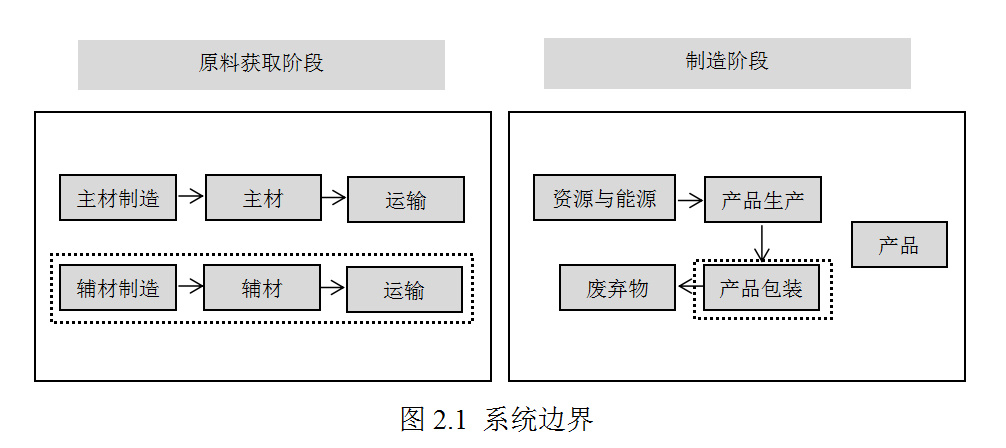
According to the actual situation of the enterprise, the verification team used PAS2050 as the evaluation standard in the process of this product carbon footprint verification, and the inventory boundary can be divided into B2B(Business-to-Business) and B2C(Business-to-Consumer). The system boundary of this inventory belongs to the type of "from cradle to gate". In order to realize the above functional units, the system boundary of product manufacturing is as shown in the figure above (the process in the dotted border is not included in the calculation of greenhouse gas emissions). This report excludes greenhouse gas emissions from:
(1) Greenhouse gas emissions from personnel-related activities are excluded;
(2) Emissions from factories, warehouses, offices, etc. are not counted due to the complex influence of various factors such as geography and factory arrangement;
Table 2.1 Production processes included and not included in the system boundary
3. Data collection
According to the requirements of PAS 2050: 2011 standard, the verification team has set up a carbon footprint inventory working group to inventory the carbon footprint of Xintai's consumption of 10,000 tons of raw materials. The working group made preliminary preparations for the product carbon footprint inventory work, then determined the work plan and scope, and completed the greenhouse gas emission inventory work through the process of consulting documents, on-site visits and telephone communication. The preliminary preparation work mainly includes: understanding the basic situation of products, production process flow and raw material suppliers and other information; Investigate and collect some original data, mainly including: production statements and financial data of enterprises, to ensure the integrity and accuracy of the data, and in the later report preparation stage, consult a large number of databases, literature reports and mature and available LCA software to obtain emission factors.
3.1 primary activity level data
According to the requirements of the PAS2050:2011 standard, primary activity level data is applied to all processes and materials, I .e. processes and materials owned, operated or controlled by the organization generating the carbon footprint. The primary activity level data in this report includes all energy and material consumption (material input and output, energy consumption, etc.) in the product life cycle system. These data are collected and measured from the enterprise or its suppliers, and can truly reflect the energy and material input of the entire production process, as well as the output of products/intermediate products and waste.
3.2 sub-activity level data
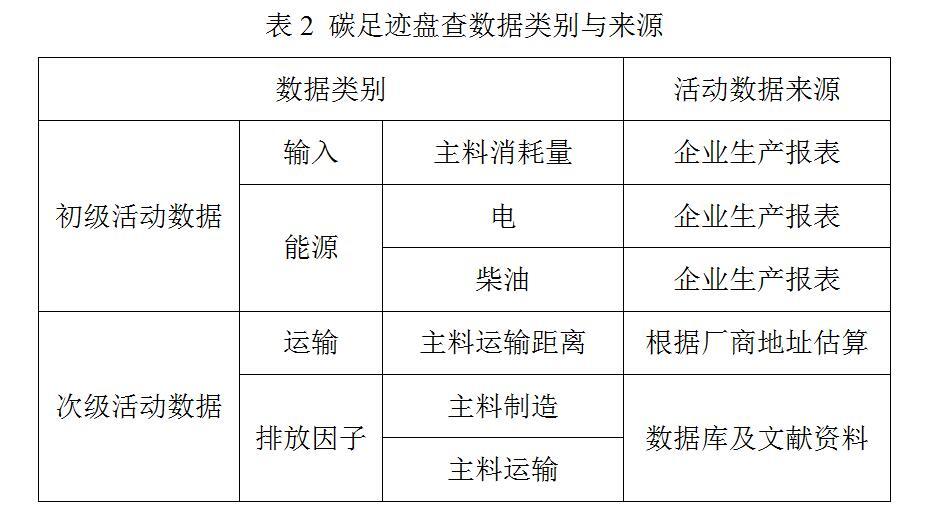
In accordance with the requirements of the PAS2050:2011 standard, where primary activity level data are not available or of questionable quality (e. g. unresponsive measuring instruments), it is necessary to use secondary data from sources other than direct measurements. The secondary activity data in this report mainly come from data in databases and literature.
The categories and sources of the data used in the calculation of the product carbon footprint are shown in Table 2.
4. Carbon footprint calculation
The formula for a product's carbon footprint is the sum of all materials, energy and waste from all activities throughout the product's life cycle multiplied by their emission factors. The calculation formula is as follows:
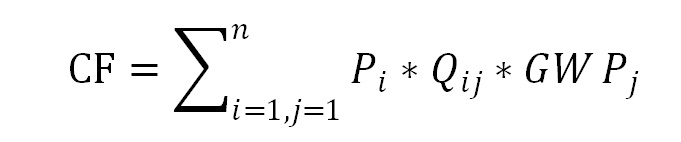
Among them, CF is the carbon footprint, P is the activity level data, Q is the emission factor, GWP is the global warming potential value. Emission factors are derived from the CLCD database and related literature, and since there are no emission factors in some material databases, the values are derived from similar material emission factors.
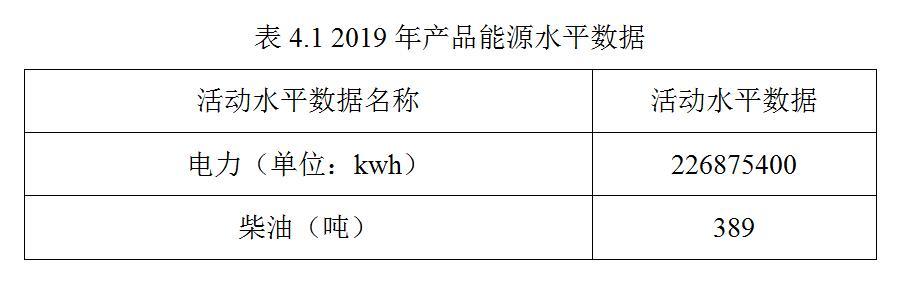
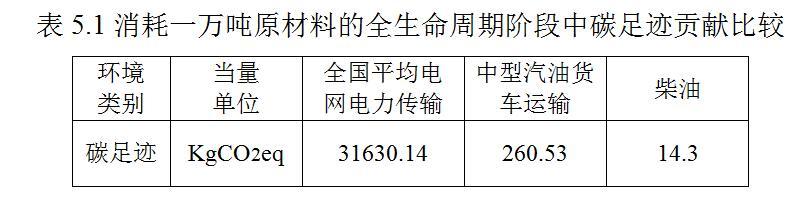
5. Carbon footprint index of raw material consumption process
6. Conclusions and recommendations
The carbon footprint of consuming one ton of raw materials is 31630.14 kgCO2eq, of which the largest share of electricity consumption in the production process is more than 99.13 per cent, followed by 0.8 per cent of consumption in the transportation process.
From the above analysis, it can be seen that the contribution of electricity consumption in the production process to the carbon footprint is as high as 96.94%. In order to enhance brand competitiveness and reduce the carbon footprint of products, the following suggestions are made:
1, in the original village material price difference is not big, try to select raw material carbon footprint small suppliers.
2, the use of renewable energy instead of non-renewable energy, reduce energy waste, while reducing carbon dioxide emissions.
7. Conclusion
Low-carbon development is the inevitable choice for the future survival and development of enterprises, and the accounting of product carbon footprint is the first step for enterprises to realize greenhouse gas management and formulate low-carbon development strategy. Through the carbon footprint accounting of the product life cycle, enterprises can understand the emission sources, clarify the emissions of each production link, and lay the foundation for formulating reasonable emission reduction targets and development strategies.
Related News
From April 20 to April 26 this year, the National intellectual property publicity week was jointly organized by the intellectual property Office, the Central propaganda Department and the General Administration of Market Supervision, together with the Supreme people's Court, the Supreme people's Procuratorate, the Ministry of Foreign Affairs, the Development and Reform Commission, the Ministry of Education, the Ministry of Science and Technology, the Ministry of Industry and Information Technology, the Ministry of Public Security, the Ministry of Justice, the Ministry of Agriculture and Rural Affairs, the Ministry, the Ministry, the Ministry, the Ministry, the Ministry of Commerce, the Ministry, the Ministry of Culture, the Ministry, national synchronization. The theme of this year's publicity week is "intellectual property transformation and application to promote high-quality development".
Fenji set sail again and ride on the dragon to compose a new chapter.
On February 16 (the sixth day of the Spring Festival in the Year of the Dragon), CCTV 13-News Channel broadcast the news that employees of Changyuan Textile and other key enterprises took the Spring Festival charter flights led by Fuzhou Human Resources and Social Security Department to return to work one after another. As of today (February 18), the employees of Changyuan Textile who have returned home for the New Year have basically returned to the company and devoted themselves with full enthusiasm to the production and operation of "setting sail again and making a new chapter on the dragon" after the festival. On the production lines of Changyuan Textile's 9 workshops, workers have concentrated on patrol inspection and operation. Thousands of spinning equipment have been operating at full capacity in the production processes of flower cleaning, carding, slimming, roving, spinning, winding and packaging. In the main control room of the digital system, the large LED color display screen scrolls and updates the real-time data of production quality, as well as scene information such as labor, equipment, energy consumption and production environment temperature and humidity. The Spring Festival of the Year of the Dragon is in good luck. In 2024, various production and operation management tasks and KPI performance indicators will be further broken down and issued for implementation.
Recently, the China Textile Industry Federation announced the results of the 2023 National Textile Industry Labor Skills Competition. Sun Yuanxiu, the head coach of the spinning operator of Fujian Changyuan Textile Co., Ltd., won the honor of "National Textile Industry Technical Expert". The competition results were 18. Ranked first among the winners of the National Textile Industry Labor Skills Competition with this honor.
Product Carbon Footprint Report
Release time:
2020-02-15 10:49
Source:
1. Product Carbon Footprint (PCF) Introduction
In recent years, the greenhouse effect and climate change have become the focus of global attention, and the new term "carbon footprint" is more and more widely used all over the world. Carbon footprint is usually divided into three levels: project level, organization level and product level. Product carbon footprint (Product Carbon Footprint,PCF) refers to the sum of greenhouse gas emissions of a product at all stages of its life cycle, I .e. the accumulation of various greenhouse gas emissions from raw material extraction, product production (or service), distribution, use to final disposal/recycling. Greenhouse gases include carbon monoxide (CO2), methane (CH4), nitrous oxide (N2O), hydrofluorocarbons (HFO), perfluorocarbons (PFC), and nitrogen trioxides (NF3), among others. The product carbon footprint is calculated as the weighted sum of the various greenhouse gas emissions over the product life cycle, expressed in carbon dioxide equivalent (CO2e), in kgCO2e or gCO2e. Global Warming Potential (GWP), the carbon dioxide equivalent value of various greenhouse gases, is usually provided by the United Nations Intergovernmental Panel on Climate Change (IPCC). At present, this set of factors is widely used worldwide.
The product carbon footprint calculation contains only the greenhouse gas component of a full life cycle assessment (LCA). Based on the LCA evaluation method, a variety of carbon footprint assessment guidelines and requirements have been established internationally for product carbon footprint certification. There are currently three widely used carbon footprint assessment standards:
(1) PAS2050:2011 Code for Evaluation of Greenhouse Gas Emissions in the Life Cycle of Goods and Services, which is jointly issued by the British Standards Institute (BSI), the Carbon Trust (Carbon Trust) and the UK Department of Food and Rural Affairs (Defra). It is the earliest standard with specific calculation methods in the world, and it is also the most widely used standard for evaluating the carbon footprint of products at present;
(2) The Greenhouse Gas Accounting System: Product Life Cycle Accounting and Reporting Standard, which is a product and supply chain standard issued by the World Resources Institute (VRI) and the World Business Council for Sustainable Development (WBCSD);
(3)(ISO/TS 14067:2013 Greenhouse Gases-Product Carbon Footprint-Requirements and Guidelines for Quantification and Information Exchange ", this standard uses PAS 2050 as a seed document and is prepared and issued by the International Organization for Standardization (ISO). The purpose of the product carbon footprint accounting standard is to establish a consistent and internationally accepted method for assessing the carbon footprint of products.
2. Definition of objectives and scope
2.1 enterprise and its product introduction
Fujian Changyuan Textile Co., Ltd. was registered and established on February 15, 2006. It is a modern large-scale private textile enterprise that mainly produces and operates various high-end textile yarns, and the industrial chain connects knitting, dyeing and finishing, clothing and home textile industries. The company is located in Fuzhou (Changle) Airport Industrial Concentration Zone, with a total area of more than 400 acres and a registered capital of 0.42912 billion yuan. As of the end of 2019, the output value is 2.8 billion yuan and the total assets are more than 4.4 billion yuan. The company has introduced the most advanced spinning equipment at home and abroad to build a spinning production line with the ability of integrating information data, and has the spinning production capacity of combining 650000 spindle ring spinning and tight siro spinning.
The company has passed the certification of ISO9001:2015 quality management system, ISO14001:2015 environmental management system, ISO45001:2018 occupational health and safety management system, and integration management system of industrialization and industrialization. It is one of the leading textile enterprises in Fujian Province and the largest chemical fiber staple yarn production enterprises in China's cotton textile industry. For many years, the company has been rated as "one hundred key industrial enterprises in the province", "leading enterprises in industrial and information industries", "backbone enterprises in strategic emerging industries", "demonstration enterprises in the deep integration of informatization and industrialization", "innovative enterprises" and "high-tech enterprises".
2.2 Research Purpose
The purpose of this study is to obtain the carbon footprint of the life cycle process of Fujian Changyuan Textile Co., Ltd. consuming "one ton of raw materials". The results of the study are helpful for the company to master the ways and emissions of greenhouse gas emissions, and help enterprises to explore the potential of emission reduction, effectively communicate with consumers, improve reputation and strengthen brand, so as to effectively reduce greenhouse gas emissions.
2.3 Carbon Footprint Scope Description
The types of greenhouse gases verified in this report include those listed in the IPCC Fifth Assessment Report, such as carbon dioxide (CO2), ozone (O3), nitrous oxide (N2O), methane (CH4), hydrofluorocarbons (CFCs,HFCs,HCFCs), perfluorocarbons (PFCs) and sulfur hexafluoride (SF6), and the method proposed by the IPCC Fifth Assessment Report (2013) is used to calculate the GWP value of the product production cycle.
In order to facilitate lightweight, the calculation of carbon footprint is defined as the carbon footprint generated by the consumption of 10,000 tons of raw materials.
The verification period is from January 1, 2019 to December 31, 2019.
The inspection place is Fujian Changyuan Textile Co., Ltd. (address: Airport Industrial Park, Changle District, Fuzhou City, Fujian Province (Hunan District)).
According to the actual situation of the enterprise, the verification team used PAS2050 as the evaluation standard in the process of this product carbon footprint verification, and the inventory boundary can be divided into B2B(Business-to-Business) and B2C(Business-to-Consumer). The system boundary of this inventory belongs to the type of "from cradle to gate". In order to realize the above functional units, the system boundary of product manufacturing is as shown in the figure above (the process in the dotted border is not included in the calculation of greenhouse gas emissions). This report excludes greenhouse gas emissions from:
(1) Greenhouse gas emissions from personnel-related activities are excluded;
(2) Emissions from factories, warehouses, offices, etc. are not counted due to the complex influence of various factors such as geography and factory arrangement;
Table 2.1 Production processes included and not included in the system boundary
3. Data collection
According to the requirements of PAS 2050: 2011 standard, the verification team has set up a carbon footprint inventory working group to inventory the carbon footprint of Xintai's consumption of 10,000 tons of raw materials. The working group made preliminary preparations for the product carbon footprint inventory work, then determined the work plan and scope, and completed the greenhouse gas emission inventory work through the process of consulting documents, on-site visits and telephone communication. The preliminary preparation work mainly includes: understanding the basic situation of products, production process flow and raw material suppliers and other information; Investigate and collect some original data, mainly including: production statements and financial data of enterprises, to ensure the integrity and accuracy of the data, and in the later report preparation stage, consult a large number of databases, literature reports and mature and available LCA software to obtain emission factors.
3.1 primary activity level data
According to the requirements of the PAS2050:2011 standard, primary activity level data is applied to all processes and materials, I .e. processes and materials owned, operated or controlled by the organization generating the carbon footprint. The primary activity level data in this report includes all energy and material consumption (material input and output, energy consumption, etc.) in the product life cycle system. These data are collected and measured from the enterprise or its suppliers, and can truly reflect the energy and material input of the entire production process, as well as the output of products/intermediate products and waste.
3.2 sub-activity level data
In accordance with the requirements of the PAS2050:2011 standard, where primary activity level data are not available or of questionable quality (e. g. unresponsive measuring instruments), it is necessary to use secondary data from sources other than direct measurements. The secondary activity data in this report mainly come from data in databases and literature.
The categories and sources of the data used in the calculation of the product carbon footprint are shown in Table 2.
4. Carbon footprint calculation
The formula for a product's carbon footprint is the sum of all materials, energy and waste from all activities throughout the product's life cycle multiplied by their emission factors. The calculation formula is as follows:
Among them, CF is the carbon footprint, P is the activity level data, Q is the emission factor, GWP is the global warming potential value. Emission factors are derived from the CLCD database and related literature, and since there are no emission factors in some material databases, the values are derived from similar material emission factors.
5. Carbon footprint index of raw material consumption process
6. Conclusions and recommendations
The carbon footprint of consuming one ton of raw materials is 31630.14 kgCO2eq, of which the largest share of electricity consumption in the production process is more than 99.13 per cent, followed by 0.8 per cent of consumption in the transportation process.
From the above analysis, it can be seen that the contribution of electricity consumption in the production process to the carbon footprint is as high as 96.94%. In order to enhance brand competitiveness and reduce the carbon footprint of products, the following suggestions are made:
1, in the original village material price difference is not big, try to select raw material carbon footprint small suppliers.
2, the use of renewable energy instead of non-renewable energy, reduce energy waste, while reducing carbon dioxide emissions.
7. Conclusion
Low-carbon development is the inevitable choice for the future survival and development of enterprises, and the accounting of product carbon footprint is the first step for enterprises to realize greenhouse gas management and formulate low-carbon development strategy. Through the carbon footprint accounting of the product life cycle, enterprises can understand the emission sources, clarify the emissions of each production link, and lay the foundation for formulating reasonable emission reduction targets and development strategies.

